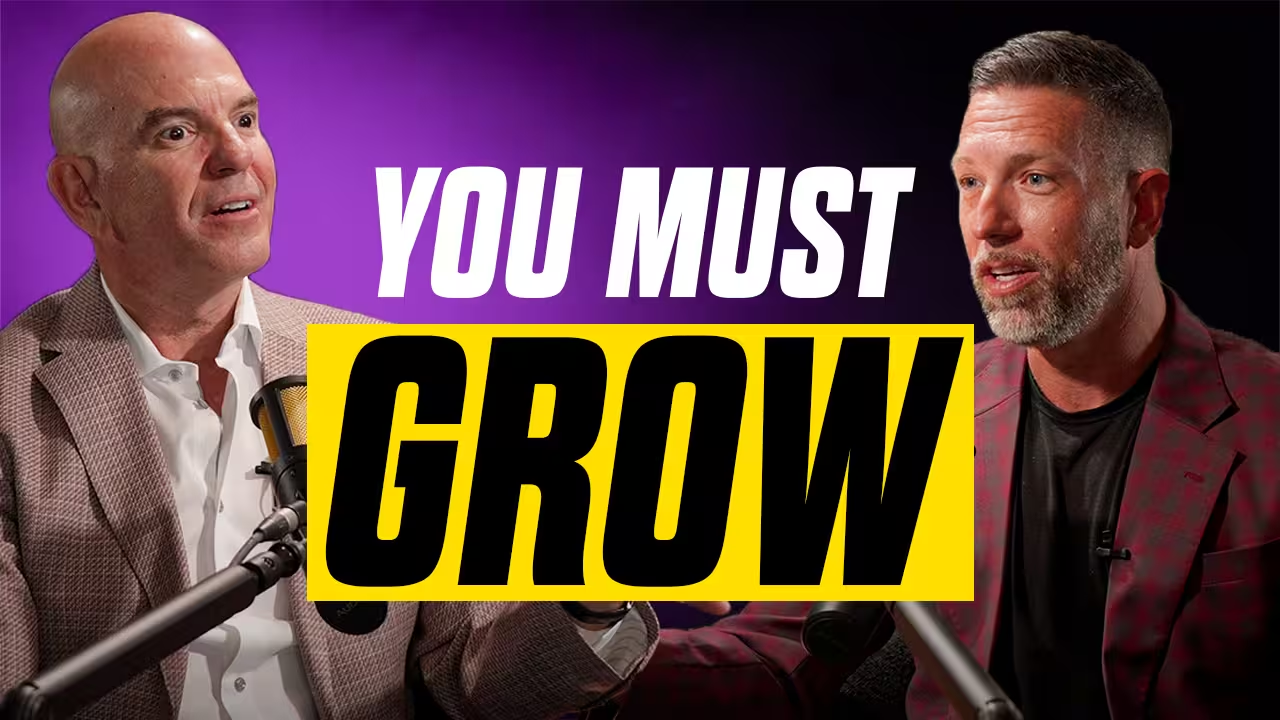



Why Most People Stop Growing After Graduation
Ian's explanation is that we are sold a timeline as children. There is a period for learning, then you grow up and do. School ends and so does the learning.
What makes it strange to him is the trade being refused. Someone spent a lifetime acquiring hard-won mastery and compressed it into a few hours you could absorb this week. Most people pass. Pew Research finds that 23 percent of American adults did not read a single book in the past year, in any format.
He borrows an old line from business writing to describe the result:
Most people think they have 30 years of experience. They have one year of experience repeated 29 more times.
They are not developing their skills, their networks, or themselves. Ian calls that a recipe for stagnation. His own framing is blunter:
"Your very best thinking, your very best belief systems, and your very best habits have gotten you exactly where you are right now. Good or bad."
Which leads to the sentence the rest of his story rests on. If you do not get better, nothing gets better. You cycle in place.
Ready to stop cycling and start building?
What Happens When You Commit to Getting Better
The opportunity that changed his life did not announce itself. It arrived as a vague remark from his boss about a man who did "this thing" on the side.
$30,000 salary at the church
10% pay cut, down to $27,000
$250 a month he needed to replace
$14.55 an hour at Rite Aid, three midnights a week
His boss mentioned a man in the congregation who did "this thing" on the side. Ian called him and asked when they could meet. The answer was an hour.
Ian grew up in a 900 square foot house and was living in a 900 square foot condo. He pulled up to a castle on a lake.
This is the moment he wants young people to sit with. He was not resentful. He saw a man who knew something about money that he did not, and concluded it would be foolish not to learn everything he could from him.
Ian is blunt that many people are taught the opposite: to dislike anyone who has more, to treat wealth as unfair rather than instructive. Successful people, he says, are glad to teach willing students. The line that matters is between people who want to contribute and people who only want to receive.
He studied under that man. The business generated millions and sold for eight figures. He is a first-generation American whose father arrived here fleeing persecution without the language. And he started the whole thing to make $250 a month.
None of it required certainty. Ian describes his approach as ready, fire, aim, and says most steps stay invisible until you take the one in front of you. The door opens after you turn the key. Victoria Raps found the same thing about playing it safe.
Why Growth Requires Someone Outside Your Own Head
Six months in, Ian was selling well but could not get investment clients. Nobody would trust him with a 401k or an IRA. He asked his mentor what he was doing wrong.
The answer was short. Cut your hair, take out your earrings. Ian had a four-inch spiked black Mohawk and large gauge earrings. People were never going to hand him their retirement savings looking like that.
He cut it. His results changed. Jason names what was happening underneath, and Ian agrees:
"You were fighting for the right to be yourself, but really you were fighting for the right to stay broke."
Ian's point is not that appearance beats substance. It is that you are not your haircut. When identity gets wrapped around something that small, ordinary feedback starts to feel like an attack.
A later mentor did the same thing with money. Ian was earning a million a year, and the man told him he was broke, because his lifestyle and his income did not reconcile. He was a high earner, not rich yet. The rule he was given:
A house worth at most one year of income.
A car worth at most one month of income.
If you do not like what that buys, go make more money.
He calls it one of the best things he ever did, and the reason he built real wealth rather than the appearance of it.
Both moments share a shape. Someone outside him saw what he could not see about himself. Ian explains why that is structural rather than personal: when you are growing, you operate at the edge of your capability, so all your attention goes into executing and none is left for observing.
It is why the top 25 golfers on the PGA Tour keep coaches, often three or four, despite being better players than the people coaching them. Greatness Lab covers the same principle in its guide to what real coaching delivers, and Coach Burt built a career on it.
Ian's warning is that most people never ask. They want to hear "good job." The question he tells his clients to ask instead:
"What is stopping me that I am unaware of?"
Does Hard Work Beat Talent?
This is where the commitment pays. Ian's answer is more precise than the cliché. Being a 10 out of 10 is not how you win. It is the entrance exam, and even then it might not be enough. Great musicians miss because their timing or their genre is wrong.
What matters is whether the ten points can be earned. In most fields, some cannot.
- Inborn: height for the NBA, pitch for a musician. No amount of practice supplies them.
- Earnable: in business, Ian says all ten points are learnable. No pedigree, bloodline, education, or birthplace required.
That is why he loves it. He describes himself as not the best at anything, just disciplined and consistent, willing to get slightly better every day while other people got comfortable. Consistency was a game he could win. Chandler Dutram explains why talented people often do not make it.
He teaches the math behind it as a formula:
A x P x T = Results
A = Amplitude. How much you do.
P = Precision. How well you do it.
T = Time. How long you have been doing it.
Double your amplitude or your precision and you reach the same result in half the time. What you cannot do is escape time, because anything multiplied by zero is zero. Ian's view is that this is by design. Time seasons you.
His gym analogy is the clearest version. Pick up a 50 pound dumbbell on your first day and it is heavy. Train for two or three years and the same weight moves easily.
"It did not get easier. I became stronger. People want the world to be easier instead of becoming stronger, and the world is never going to be easier. But we can be better."
Find an employer who will develop you instead of settling you.
What Ian Prukner Tells 22-Year-Olds Who Do Not Know What to Do
Jason asked directly. Ian gave three answers, and they run in the order his own life ran.
1. Decide what life you want, then find someone who has it. Take a few minutes on what matters to you and why. Then find a person living that life, serve them, and study underneath them. Ian calls this the fastest route there is.
2. Get religious about self-development. You are your own greatest asset. Better mindset, better beliefs, better skills and habits, better at receiving feedback. Become a permanent student.
3. Jump. Believe in yourself enough to take the next step without seeing how the rest assembles.
Ian says he could not have written his own life in advance, and that most people are limited by what they think it should look like, dismissing anything that does not match the picture.
The people who talk you out of things are usually not enemies. They are parents and partners who love you and are projecting their own fear. His line is that good advice from a bad perspective is still bad advice, and that nobody, not even the people closest to you, knows what you have in you. Tommy Nickerson makes the same case about listening to the wrong voices.
Whether you build your own venture through the TTPB Incubator Hub or join a team that will develop you, the deciding factor is the same. Learn more about the platform, or book a speaker who has done it.
Common Questions About Personal Growth and Career Success
Why is personal growth important for your career?
Because your results track your development, not your intentions. Ian Prukner puts it plainly: your best thinking, beliefs, and habits have produced exactly the life you have right now, so if you do not get better, nothing gets better. He also warns against resenting people who have more than you, because they are the ones positioned to teach you. Start by naming the life you want, then find someone living it and learn directly from them.
How do you know if you have stopped growing?
Look at whether your years are accumulating or repeating. Ian Prukner borrows an old line about people who believe they have 30 years of experience when they have one year repeated 29 times. Three signs are worth checking: you have not learned a skill you did not have last year, you cannot name recent feedback that changed how you work, and nobody in your circle knows more than you do about what you are trying to build. Any of the three means you are maintaining rather than developing.
How do you take criticism without getting defensive?
Separate the feedback from your identity. Ian Prukner was told to cut his Mohawk and remove his earrings before clients would trust him with their money, and acting on it changed his results. His structural insight is that when you are growing, you operate at the edge of your capacity, so all your attention goes into doing and none is left for observing yourself. That is why the top PGA golfers keep coaches who are worse players than they are. Rather than waiting for feedback, ask for it: what is stopping me that I am unaware of?
Does hard work beat talent?
Partly. Ian Prukner frames talent as the entry fee rather than the win: you need to be a 10 out of 10, and even that may not be enough. What matters is whether the required points can be earned. Height for basketball and pitch for music cannot be. In business, he says every point is learnable, which makes it the rare field with no prerequisites of background, education, or pedigree. His own edge was consistency, getting slightly better daily while others grew comfortable.


.avif)