



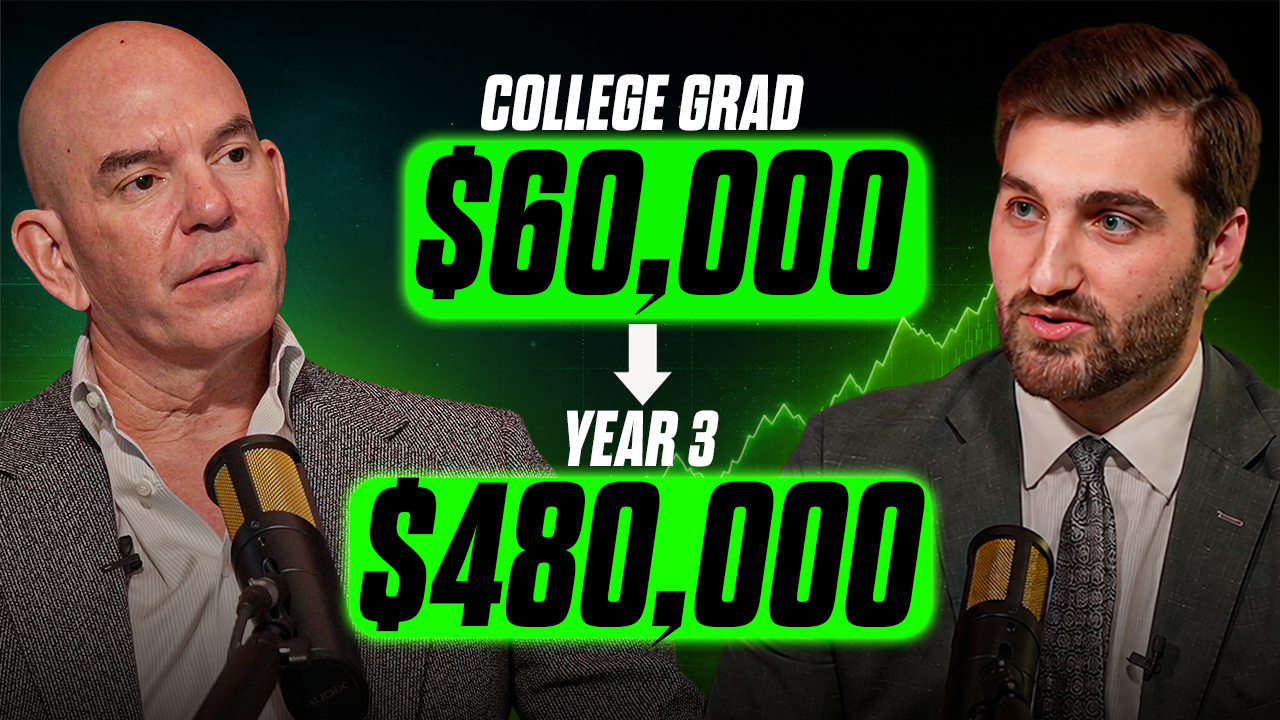
How Do You Increase Your Income Out of College?
Marshall's answer starts with arithmetic. Most people in his office worked eight to ten hours a day. He worked fourteen to fifteen. That gap, six or seven extra hours a day, added up to about thirty additional hours a week. Run that over a year, then three years, and the difference stops being a line and becomes a curve. He describes the effect as exponential, and the result was that he overtook colleagues who had a head start on him. Each year his income doubled.
His firm has a saying he repeats: quantity fosters quality. You do not develop a skill by studying it once. You develop it by doing the thing many times, and the volume itself produces the polish. Marshall applies the same logic to finding clients. Reaching out to as many people as possible is what surfaces the big cases. He compares it to at-bats in baseball. The more pitches you face, the faster you learn to hit the curveball, and the person who never steps up to the plate never learns at all.
He learned the pattern as a college lacrosse player, where the edge came from the work done outside the three scheduled practices, on the weekends, throwing and shooting alone. Someone more naturally gifted might lead for a month or a year, but consistent extra reps close the gap and then open one the other way. Sami Dongle, who works at the same firm, built his own fast rise on a nearly identical idea, told in how he rose to the top of the company.
Be sure to embed Youtube
Willing to bet on yourself instead of settling for a salary? Join the TTPB community and connect with employers who reward effort with real upside.
How Do You Stay Motivated in a Hard Sales Job?
Marshall is honest that the hardest part of the work is emotional, especially straight out of school with no experience of the real world. The job swings between good stretches and bad ones, and the people who wash out are usually the ones who cannot sit with the volatility. He has specific tactics for getting through it, and they are simple enough to use on a bad day.
The first is to change your state. When he is in a bad headspace, he steps away and takes a fifteen-minute walk outside, lets himself settle, and comes back to the office with a clearer mind. He picked the idea up from a Tony Robbins talk early in his career, and it works because a reset breaks the spiral before it takes over the rest of the day. The second is to choose who you are around when things are hard. He deliberately seeks out the people in the office who are having success and staying optimistic, because their energy pulls him back up faster than sitting alone in the slump would.
Underneath the tactics is purpose. If you know why you are doing the work, the daily key activities become easy to repeat whether the day went well or badly, and results follow from the repetition. Marshall frames failure as on the way rather than in the way, an obstacle on the path instead of a wall across it. The payoff is real: he says he has never seen someone last past twelve to twenty-four months in the job who was not wildly successful. The tactics are what carry you to that point.
How Do You Choose a First Job That Will Not Cap Your Income?
Marshall has clear advice for graduates, and it comes down to two things. First, take a role with uncapped income, where more effort translates directly into more earnings. Second, take a role with fast upward mobility into leadership. He values the second as much as the first, because stepping into leadership early forces you to support and teach other people, and teaching others reinforces what you know and accelerates your own development.
The trap he warns against is the comfortable salaried job where the incentives are not aligned. If you are paid the same whether you work eight hours or twelve, there is no built-in reason to push, and many people settle into that and never leave. He is direct that complacency early can set the ceiling for an entire career. The fix is to choose a role where doing more is rewarded with more, so your own ambition has somewhere to go.
He frames it as a shift in language, too. Stop deciding what you will and will not do, and start asking what you can and cannot do. The first limits you before you begin. Mike Karsa made the same call, choosing an uncapped, client-facing path over a safe analyst seat, a decision he explains in how he escaped being average.
Find a first job with real upside and room to lead. Browse roles built for people who want to move fast.
How Do You Lead and Develop a Team as a New Manager?
The most striking thing about Marshall is not his income. It is that from the day he walked in, he was trying to replace himself. Most people guard their role and try to make themselves indispensable. He did the reverse on purpose. His view is that the weak protect, and that protecting your job keeps you stuck in it. If you want to move up, you have to build someone who can do what you do, so you are free to take the next thing. When he opens an office, his first priority is developing one or two people fast, because they become the support structure that lets the whole operation grow.
That means teaching transferable skills rather than cloning himself. He cannot give someone his exact social style, so he focuses on the parts of the job that move from one person to another: how to make the call, how to run an introductory meeting, how to sell a financial plan. Each person then adapts those skills to their own way of working. This is the discipline that let a 25-year-old run offices and develop future leaders rather than stay a high producer with no leverage. Justin Barbato reaches a similar place on young leadership in how to become an executive in your 20s.
How Do You Turn Around an Underperforming Team?
Marshall's hardest test was a turnaround. He took over an existing office in Austin that the previous leader had left in poor shape, with a weak work ethic and people set in their opinions. Flipping a culture is the toughest part of the job, and rushing it does not work. His first move was to inspect rather than act. He spent the opening couple of weeks watching what was working and what was not before he changed anything.
Then he went after a few key people rather than the whole room at once. He found two or three he could get real wins for, helped them produce, and got them paid. Those early wins bought loyalty, and the loyal few became the people who carried the culture change through the rest of the office. He worked from the bottom up rather than issuing orders from the top, because a base that buys in is what turns a place around. As an old line at his firm puts it, if you cannot change the people, you change the people, but the better path is turning one or two doubters into believers and letting that spread.
What Can Your First Job Teach You That College Cannot?
Marshall is blunt about where his real education came from. He says he learned more in two to three years in this role than he did across eight, nine, or ten years of schooling. The job taught him how to work with discipline, how to be consistent, and how to take feedback and be coached rather than defend himself. It expanded his sense of what was possible when he applied himself, which a classroom never did.
This is the heart of why the bet paid off. The right job is not only a paycheck. It is the place where the skills that compound across a career get built, and they get built faster under real pressure than in any lecture. For a graduate deciding between a safe seat and a demanding one, that is the case for the demanding one. You are not only choosing income. You are choosing how fast you grow.
Common Questions From New Graduates About Career Growth
How do you get promoted quickly in your first job out of college?
Out-work your peer group and make yourself replaceable. Marshall Ellison worked roughly thirty more hours a week than his colleagues, which compounded into faster skill growth and results that earned promotions. He also developed people who could do his job, which freed him to take on more. Find the top performer in your office, copy their daily activities exactly, put in more reps than anyone else, and train others so you are always ready for the next role.
Is being young a disadvantage when advising older clients?
It is usually an advantage. Marshall Ellison began advising clients in their fifties and sixties at age 22 and found that older clients often prefer a younger professional. A client approaching retirement wants an advisor who will be there for the entire journey, and a young advisor offers that longevity. If you feel imposter syndrome early on, treat it as self-talk rather than fact, stop over-weighting opinions that do not matter, and let consistent results build your confidence over time.
What should you look for in your first job after graduation?
Look for uncapped income and fast access to leadership. Marshall Ellison advises graduates to choose a role where more effort earns more money, rather than a salaried job where the pay is the same no matter how hard you work. He pairs that with upward mobility, because moving into leadership early forces you to teach others, which accelerates your own growth. Avoid roles that breed complacency, since early comfort can cap a career.
How do you push through the ups and downs of a commission job?
Reset your state and lean on people who are winning. When a day goes badly, Marshall steps away for a short walk to clear his head before returning, a technique he took from a Tony Robbins talk, and he seeks out colleagues who are succeeding and staying positive. The deeper fix is a clear purpose, which turns the inevitable bad days into obstacles on the way rather than reasons to quit. Most people who last past twelve to twenty-four months end up successful.


.avif)