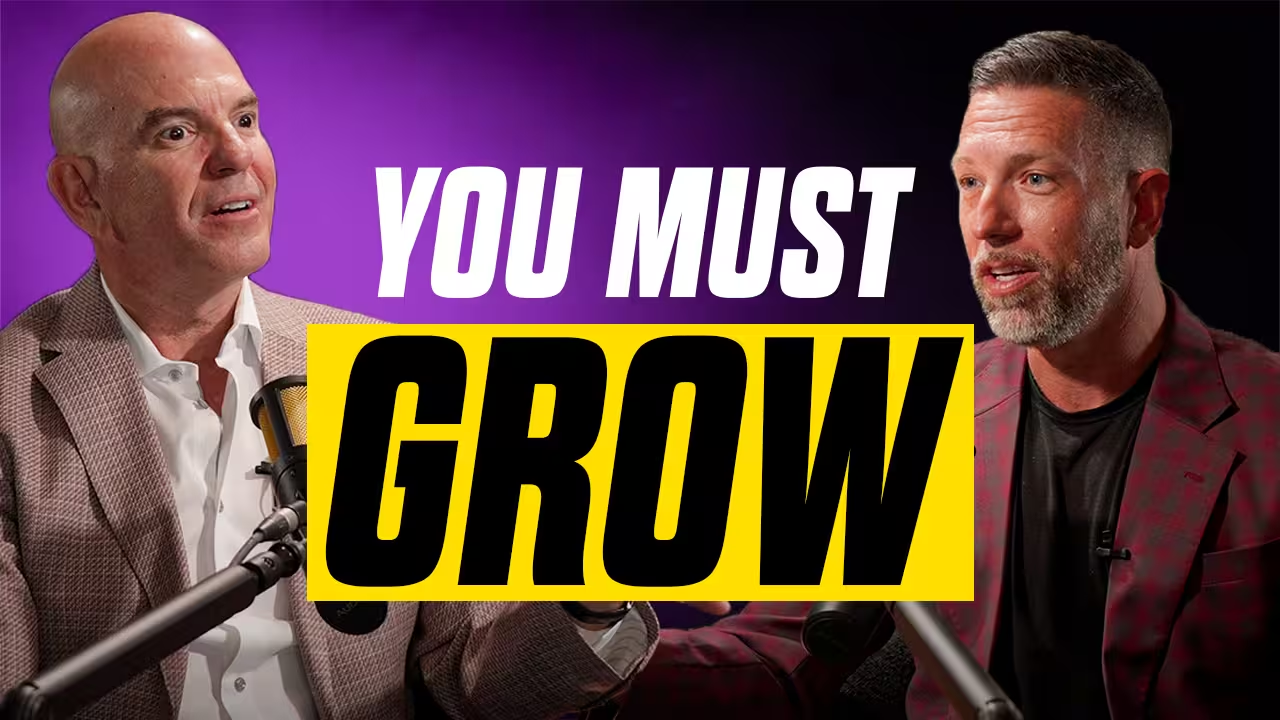




Rob Luna's Start: Growing Up With Nothing in Los Angeles
Rob was eight years old when his family moved to Los Angeles from New Jersey. He grew up in heavily gang-influenced neighborhoods during the 1980s, when drive-by shootings were a routine part of daily life. His brother got caught up in it. Friends were killed.
At 16, a police officer who had seen Rob in multiple interactions pulled him aside and said something no one had ever said to him: you are different from these kids, and you need to get out.
"It was the first time anyone in my life had really said something positive to me. Everything was the opposite. You're not gonna be anything. You're garbage."
That moment planted a belief that had no evidence behind it yet. Rob held onto it anyway. At 18, a partial wrestling scholarship to a school in Arizona became his exit. He took it, hated the heat, and stayed anyway. He bought his first home at 19. He worked two jobs through his undergraduate years. It took him seven years to finish his degree.
That is the background no resume line captures. If you are a student looking for a path that rewards that kind of drive, start by exploring what Take The Power Back offers.
How a Newspaper Ad Changed the Trajectory of a Career
Rob had originally planned to become a psychiatrist. He spent his first year of college working at a youth facility, building toward that path. When the facility lost its license and closed, he was unemployed and needed income. He owned a home. The stakes were immediate.
A newspaper ad for a stockbroker trainee caught his eye. He applied. He showed up. They handed him Series 7 study materials and gave him 90 days to pass.
"It got to options, and I was scared to death. I was like, this is not regular math. Puts, calls. I was in the library reading every book I could find on options."
Ninety days later, Rob passed on the first attempt with a perfect score on the options section. He became an options principal for the firm within a year or two. What started as a survival decision became a 20-year foundation in wealth management.
The psychology matters here. Rob did not arrive knowing the material. He arrived willing to become someone who did. He identified what the exam required, found the gap between where he was and where he needed to be, and filled it.
Building a $1 Billion Firm: The First 10 Years Were a Grind
Rob started his own registered investment advisor firm from his bedroom at 27. He did not know what an RIA was two years before that. He had spent a year building one for someone else, and that person did not follow through on the partnership agreement they had discussed.
So Rob gave two weeks notice, took one client who had not yet signed, and started over. He filed paperwork with the state. He waited in line at the post office because he could not afford FedEx. He was in networking groups, doing trades, managing investments, and handling compliance entirely on his own until he could afford his first assistant.
"I knew exactly what your job is because I've done it. Every single job inside an RIA firm, I have done it."
The first major inflection point came in 2009, when Levi Brown, an offensive lineman for the Arizona Cardinals, signed a $62 million contract. That deal, the highest ever for an offensive lineman at the time, generated coverage in Sports Illustrated and on the front page of the Arizona Republic. It positioned Rob's firm differently.
Before the deal, Rob had spent years chasing clients. After it, clients started coming to him. The firm crossed what had been a ceiling, and the game changed from activity to attraction.
If you want to connect with professionals who have built careers the hard way and are now in a position to hire, browse jobs in the Take The Power Back job center.
The ACE Strategy That Rob Luna Credits for Every Career Win
When Jason Mickool asked Rob how he attracted high-net-worth clients, Rob pointed to a framework he first heard from marketing strategist Dan Kennedy in his early twenties: Authority, Celebrity, and Exclusivity.
Authority takes the longest. It is the degrees, the designations, the years of experience, the late nights studying options theory. It cannot be shortcut. It is what separates someone who can speak credibly in a room from someone who is performing confidence.
Celebrity means people know about you. Rob used books, television appearances on Fox Business and CNBC, and eventually social media. He is direct about the tradeoff: Instagram and YouTube now deliver more immediate impact than network television. Someone who watches you on Fox might recognize you at a dinner. Someone who follows you on social media can book a meeting the same day.
"You could be the greatest at anything you do, but if nobody knows about you, it's not going to work."
Exclusivity follows from the first two. Once you are established as an authority and people know who you are, you stop saying yes to everything. You choose clients whose problems match your expertise. You stop chasing and start selecting.
Rob added a fourth element on his own: Delivery. When a client calls during dinner, he texts back immediately. When a family office has a question at an inconvenient hour, he responds. Reputation is built over years of that behavior, not announcements about it.
If you are building your own path toward authority in your field, the Take The Power Back Incubator Hub is where students who are serious about entrepreneurship start.
Selling a Firm and Starting Over: What Rob Luna Built After the Exit
Rob sold his firm, Surevest, to CI Financial in 2019. He had come close to selling to Wedbush Securities three years earlier but walked away after discovering a contract violation at the signing table. Three years later, an unsolicited offer came in at a better price. He took it.
He had a three-year earn-out, followed by a non-compete that kept him out of the high-net-worth space until mid-2025. During that time, he built a Wealth Academy with weekly online education sessions, launched a consulting practice for entrepreneurs, and thought carefully about what he actually wanted to build next.
"The business I started at 27 versus what I realized in my late thirties were two different things. I had cost structures I could not change. I had advisors I could not fire. I had clients I could not let go."
What he built after the exit is a full ecosystem: an RIA, an insurance division, a lending operation, and a consulting practice focused on helping entrepreneurs build and exit their own companies. Most of his time now goes to strategy work with entrepreneurs and family offices who are pre-exit and want to structure things correctly from the start.
His advice is consistent: do not build a business that is entirely dependent on you. The clients he saw fail after their exits were the ones who built patchwork firms with the wrong people on the bus, clients who paid too much to lose, and processes that could not survive without the founder at the center.
Hear from more professionals who have built, exited, and started again by visiting the Take The Power Back success stories page.
Your Questions About Building Wealth From Nothing
How did Rob Luna go from poverty to building a billion-dollar firm?
Rob Luna built his RIA firm from his bedroom at 27 with one client, grew it to nearly $1 billion in assets over 20 years, and sold it to CI Financial in 2019 through two decades of expertise, referral relationships, and the ACE strategy of authority, celebrity, and exclusivity.
How do you build wealth when you have no money and no connections?
Start by building one skill so deeply that it becomes undeniable. Wealth built from nothing follows a consistent pattern: the person identified a specific area, went all in on mastering it, and used that expertise as the entry point into rooms they could not otherwise access. A general skill set does not open those doors. A specific, verifiable one does. Begin with what you can learn right now with the resources you have. Then go deeper than anyone around you is willing to go. The money follows competence. It does not precede it.
Is it realistic to build a career in financial services without connections or a wealthy background?
Yes, and financial services is one of the few industries where demonstrated results replace pedigree over time. The barrier to entry is a licensing exam, not a family network. The people who build significant careers in this field typically start by mastering the technical foundation others avoid, options, risk, tax strategy, estate planning, and use that expertise to get into conversations with people who have more resources and experience. Each of those conversations becomes the next door. It takes longer without a network behind you. It is not impossible, and the people who do it without one tend to understand the business more completely than those who inherited their book of business. Most importantly, you need to align with leaders like Jason Mickool, or become affialiated a company like his, to learn and get the systems and practices to help you scale.
What is the ACE strategy Rob Luna uses for career growth?
ACE stands for Authority, Celebrity, and Exclusivity. Build deep expertise first, make sure people know about it through media and social platforms second, then attract clients selectively rather than chasing them. Rob added a fourth element, Delivery, meaning consistent responsiveness to clients who value their time.
Should young people take the highest-paying job or the most valuable one?
Take the most valuable one. A $50,000 position that puts you in rooms with high-caliber professionals, exposes you to how complex problems get solved, and gives you proximity to people who are further ahead is worth more than a $100,000 salary with a ceiling. Early career years are the one period when you can trade income for access and have the math work in your favor. The learning you acquire in years two through five compounds the same way money does. The people who figure this out early spend their later years being sought out. The ones who optimize for immediate income spend those same years wondering why growth has stalled.
What is the long game in building wealth, and how do you stay committed to it?
The long game means making decisions based on where you want to be in 20 years, not what pays off this quarter. In practice, it looks like taking jobs for the relationships rather than the salary, building expertise in areas that take years to master, and resisting shortcuts that feel good now but limit options later. Staying committed is easier when you define your North Star first: what does your ideal life actually look like, and what does it require financially? Once that is clear, you reverse engineer every career decision against it. Not every job is a good job. Not every client is a good client. Not every paycheck moves you toward that goal. The long game is not about patience. It is about clarity
Have more questions? Visit our FAQ page or contact us directly.


.avif)